Tesla owners in New Jersey love their vehicles—until they don’t. The cutting-edge technology, instant acceleration, and over-the-air updates create an ownership experience unlike any traditional car. But when something goes wrong with a Tesla, the frustration can be just as unique.
Touchscreens that freeze mid-drive. Full Self-Driving that doesn’t. Charging ports that refuse to open. Suspension systems that fail prematurely. Paint defects straight from the factory.
If you’re experiencing repeated issues with your Tesla, you need to know this: New Jersey’s Lemon Law fully protects Tesla owners.
Whether you own a Model 3, Model Y, Model S, Model X, or even a Cybertruck, you have the same consumer rights as any other vehicle owner in the state.
This guide will walk you through how New Jersey’s Lemon Law applies to Tesla vehicles, the most common defects we see, how recalls and over-the-air updates factor into your case, and the steps you need to take to protect your rights.
New Jersey’s Lemon Law Covers Tesla Vehicles
Under N.J.S.A. 56:12-29 to 56:12-49, New Jersey’s Lemon Law applies to all new motor vehicles sold or leased in the state, including electric vehicles like Tesla. The law provides protection if:
- Your vehicle has a substantial defect that appeared within 24 months or 24,000 miles (whichever comes first)
- The manufacturer has had a reasonable number of attempts to fix the defect (typically 3+ attempts for the same issue, or 20+ cumulative days out of service)
- The defect substantially impairs the use, value, or safety of the vehicle
Tesla vehicles are not exempt. In fact, because Tesla combines automotive engineering with complex software systems, Teslas often present unique lemon law scenarios that traditional manufacturers don’t face.
How Tesla’s Warranty Aligns with NJ Lemon Law
Tesla offers one of the most comprehensive warranties in the automotive industry:
- Basic Vehicle Warranty: 4 years or 50,000 miles
- Battery & Drive Unit Warranty: 8 years (with varying mileage limits depending on the model)
New Jersey’s Lemon Law protection window is 24 months or 24,000 miles—which falls comfortably within Tesla’s Basic Vehicle Warranty.
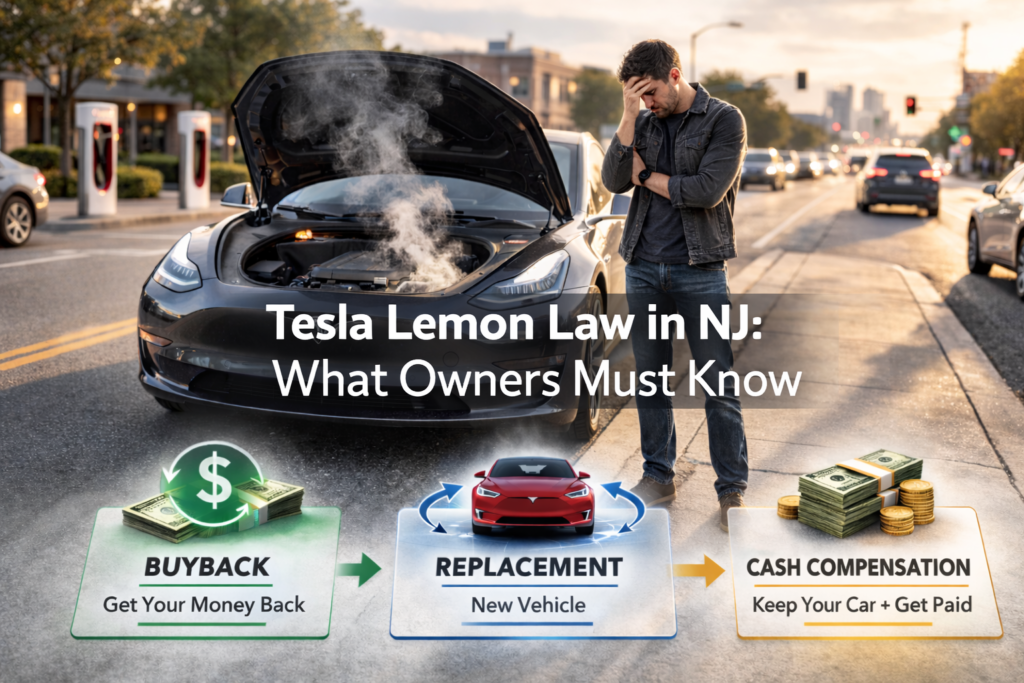
Here’s what this means in practice: If your Tesla develops a recurring defect within the first 2 years or 24,000 miles, and Tesla can’t fix it after a reasonable number of attempts, you’re entitled to a buyback, replacement, or cash settlement under New Jersey law.
After the 24-month window closes but while your vehicle is still under Tesla’s warranty, you can pursue a claim under the Magnuson-Moss Warranty Act, a federal law that provides similar protections with different procedural requirements.
Most Common Tesla Defects in New Jersey
Tesla vehicles are technological marvels, but they’re not immune to defects. Based on our experience representing New Jersey Tesla owners, here are the most common issues we see:
1. Full Self-Driving (FSD) and Autopilot Failures
Tesla’s advanced driver-assistance systems are a major selling point—but when they malfunction, they create serious safety concerns. Common FSD/Autopilot issues include:
- Phantom braking: The vehicle suddenly brakes for no apparent reason, creating rear-end collision risks
- Lane-keeping failures: The car drifts out of its lane or jerks back and forth
- Failure to detect obstacles: The system doesn’t recognize stopped vehicles, pedestrians, or road debris
- Unexpected disengagement: Autopilot shuts off without warning, sometimes in dangerous situations
These aren’t minor inconveniences. When a safety system fails repeatedly, it can qualify as a substantial defect under New Jersey’s Lemon Law.
2. Touchscreen and Infotainment Failures
Tesla’s center touchscreen controls nearly every vehicle function—climate, navigation, mirrors, wipers, and more. When the screen fails, the vehicle becomes nearly unusable. Common touchscreen issues:
- Complete screen blackout: No display, no access to controls
- Frozen screen: Display shows but doesn’t respond to touch
- Rebooting loops: Screen continuously restarts while driving
- Unresponsive controls: Touch inputs don’t register or register incorrectly
Tesla has issued multiple recalls for touchscreen failures, particularly in Model S and Model X vehicles from certain model years. If the recall repair doesn’t fix your screen, or if the problem returns, you may have a lemon law claim.
3. Suspension and Alignment Problems
Multiple Tesla models—especially the Model S and Model X—have documented suspension issues. Defects include:
- Ball joint failures: Suspension components break prematurely
- Alignment issues that won’t hold: Vehicle constantly pulls to one side, requiring repeated alignments
- Excessive tire wear: Uneven or rapid tire wear due to suspension defects
- Noise and vibration: Clunking, rattling, or shaking while driving
Tesla has issued service bulletins for some of these issues, but if your vehicle requires repeated suspension repairs within the lemon law protection window, you may be entitled to relief.
4. Charging Port Malfunctions
The charging port is essential to vehicle operation. When it fails, you can’t charge your car—rendering it useless. Common charging port defects:
- Port door won’t open: Mechanical failure prevents access to the charging port
- Charging port won’t release the cable: You can plug in but can’t unplug
- Intermittent charging failures: Sometimes charges, sometimes doesn’t
- Charging speed issues: DC fast charging doesn’t work or charges extremely slowly
If Tesla can’t permanently fix a charging port issue after multiple attempts, the vehicle substantially loses its value and use.
5. Paint, Panel Fit, and Build Quality Defects
Tesla has faced criticism for inconsistent build quality, particularly in earlier Model 3 and Model Y production runs. Quality issues include:
- Paint defects: Orange peel texture, thin paint, premature chipping or peeling
- Panel gaps: Uneven spacing between body panels, doors, trunk, or hood
- Water leaks: Seals that allow water into the cabin or trunk
- Trim pieces falling off: Interior or exterior trim that detaches or doesn’t fit properly
While cosmetic-only issues generally don’t qualify under lemon law, defects that affect vehicle function—like water leaks causing electrical problems—absolutely do.
6. Rearview Camera and Sensor Failures
Backup cameras are federally mandated safety equipment. When they fail, the vehicle is not only annoying to use—it’s potentially unsafe and may not be street-legal. Common camera/sensor issues:
- Camera goes black or shows “No Image Available”
- Delayed camera display: Camera takes 10-30 seconds to activate when shifting into reverse
- Distorted or pixelated image
- Parking sensors give false warnings or fail to detect obstacles
If Tesla can’t resolve camera or sensor failures after multiple service visits, the safety implications can support a lemon law claim.
Does a Tesla Recall Count as a Repair Attempt?
This is one of the most common questions we get from Tesla owners: “Tesla issued a recall for my problem. Does that count toward my lemon law case?”
The answer: It depends.
When a Recall Supports Your Lemon Law Claim
A recall can absolutely strengthen your case if:
- You had your vehicle serviced for the issue before the recall was issued
- You complied with the recall, but the problem persisted after the recall repair
- The recall repair created new problems or failed to resolve the original defect
In these scenarios, both your pre-recall service visits and post-recall repairs count as repair attempts under New Jersey law.
When a Recall Alone Isn’t Enough
If Tesla issues a recall and the single recall repair fully resolves the problem with no further issues, that typically won’t meet the lemon law threshold. New Jersey requires either:
- Three or more repair attempts for the same substantial defect, OR
- 20 or more cumulative days the vehicle is out of service for repairs
A one-time recall repair that works doesn’t meet these criteria.
Example: Touchscreen Recall
Tesla recalled approximately 135,000 Model S and Model X vehicles in 2021 for touchscreen failures caused by flash memory degradation. If you experienced touchscreen failures before the recall, had the recall repair performed, and the screen still fails after the recall, those post-recall failures count as additional repair attempts.
Document everything: both your pre-recall service history and any issues that occur after the recall repair.
Do Over-the-Air Software Updates Count as Repair Attempts?
Tesla’s over-the-air (OTA) update capability is innovative—but it also raises unique lemon law questions.
When OTA Updates Do Count
An OTA software update can count as a repair attempt if:
- You reported a specific defect to Tesla
- Tesla issued an OTA update explicitly intended to fix that defect
- The update either failed to fix the problem or made it worse
Example: You report phantom braking issues. Tesla tells you an upcoming software update will resolve it. The update is pushed to your car, but phantom braking continues. That OTA update counts as a failed repair attempt.
When OTA Updates Don’t Count
Generic software updates that Tesla pushes fleet-wide for general improvements (not targeted at your specific complaint) typically don’t count as repair attempts. Similarly, if you never reported the issue to Tesla and they coincidentally push an update that happens to address it, that’s not a repair attempt in the legal sense.
Documentation is Critical
For OTA updates to count in your lemon law case, you need:
- Written communication to Tesla about the specific defect (through the app, email, or service visit)
- Records showing when the OTA update was applied
- Documentation that the problem persisted after the update
Tesla’s service records don’t always capture OTA update details the way they do physical service visits, so keep your own records.
Model-Specific Guidance
Model 3
The best-selling Tesla in New Jersey, Model 3s are generally reliable but have documented issues with:
- Paint quality (especially on earlier production units)
- Touchscreen responsiveness
- Suspension noise
- Door handle failures (on older models with retractable handles)
NJ Tip: Model 3 is covered under the full NJ Lemon Law protection if purchased or leased new.
Model Y
Tesla’s compact SUV shares many components with the Model 3 but has its own unique issues:
- Rear cargo area water leaks
- HVAC system failures (weak cooling or heating)
- Phantom braking on Autopilot
- Tail light condensation
NJ Tip: Model Y qualifies for NJ Lemon Law protection. We’ve successfully handled multiple Model Y cases in New Jersey.
Model S
Tesla’s flagship sedan, especially older models, has experienced:
- Air suspension failures
- Touchscreen MCU failures (subject to recall)
- Door handle malfunctions
- Battery degradation beyond normal wear
NJ Tip: Model S vehicles fall under NJ Lemon Law if defects appear within 24 months/24,000 miles of original delivery.
Model X
The premium SUV with distinctive falcon-wing doors has unique challenges:
- Falcon-wing door sensor and alignment issues
- Suspension component failures
- Windshield stress cracks
- Infotainment system freezing
NJ Tip: Falcon-wing door problems that prevent proper operation can qualify as substantial defects affecting vehicle use and safety.
Cybertruck
Tesla’s newest and most unconventional vehicle is just hitting New Jersey roads. Early reported issues include:
- Stainless steel panel fit and finish problems
- Wiper motor failures
- Touchscreen glitches
- Suspension and alignment issues
NJ Tip: Cybertruck is covered under NJ Lemon Law. Given its recent release, be especially diligent about documenting any early defects.
Other Qualifying EVs in New Jersey
While Tesla dominates New Jersey’s EV market, other electric vehicles also qualify for lemon law protection:
- Volkswagen ID.4: Battery management issues, software glitches
- Chevrolet Bolt EV/EUV: Battery recall history, charging problems
- Rivian R1T/R1S: Build quality issues, software bugs (newer to market)
- Hyundai Ioniq 5/6: Charging system failures, 12V battery drain
- Ford Mustang Mach-E: Infotainment crashes, charging port issues
- Nissan Ariya: Software update failures, range discrepancies
If you own any EV with recurring defects in New Jersey, you have the same lemon law rights as Tesla owners.
How to Document Tesla Service Appointments
Proper documentation is the foundation of any successful lemon law case. With Tesla’s app-based service system, documentation looks a bit different than traditional dealerships.
What to Save
1. Tesla App Screenshots
Capture screenshots of:
- Service requests you submit through the app
- Service appointment confirmations
- Updates from Tesla service centers
- Communication from your assigned service advisor
2. Service Order PDFs
After each service visit or mobile service appointment, request:
- A copy of the service order in PDF format
- Detailed technician notes (sometimes you need to specifically request these)
- Parts replaced or adjusted
- Final diagnosis
3. Written Communication
Save all:
- Emails from Tesla service
- Text messages from service advisors
- Responses from Tesla customer support
4. Personal Records
Keep a log with:
- Date symptoms first appeared
- How the defect affects your use of the vehicle
- Dates and mileage at each service visit
- Number of days vehicle was out of service
Mobile Service Visits Count Too
Tesla’s mobile service is convenient, but some owners worry these visits won’t count toward a lemon law case. They absolutely do.
Mobile service visits are official repair attempts. Make sure you receive documentation for every mobile service visit, just as you would for a service center visit.
The Fee-Shifting Provision: Zero Cost to You
One of the most powerful aspects of New Jersey’s Lemon Law is the fee-shifting provision. Under N.J.S.A. 56:12-42, if you prevail in your lemon law case, the manufacturer must pay:
- All reasonable attorney’s fees
- All litigation costs and expenses
- Expert witness fees (if applicable)
What this means for you: You pay nothing out of pocket to pursue your lemon law claim.
Experienced lemon law attorneys work on a contingency basis backed by the fee-shifting statute. If you don’t win, you don’t pay. If you do win, Tesla (or any other manufacturer) pays your legal fees directly.
There is zero financial risk to pursuing a legitimate lemon law claim in New Jersey.
What to Expect in a Tesla Lemon Law Case
If you have a qualifying defect and proper documentation, here’s the typical process:
Step 1: Free Consultation
An experienced NJ lemon law attorney will review:
- Your service history
- The nature and severity of the defect
- Whether you meet the statutory requirements
Step 2: Demand Letter
If you have a valid case, your attorney sends a formal demand letter to Tesla, notifying them of your lemon law claim and demanding a buyback, replacement, or settlement.
Step 3: Negotiation
Most cases settle at this stage. Tesla’s legal team will review your claim and typically make an offer within 30-60 days. Your attorney negotiates on your behalf to maximize your recovery.
Step 4: Arbitration or Litigation (If Necessary)
If settlement negotiations fail, the case may proceed to arbitration or court. Your attorney handles all aspects of this process.
Throughout, you pay nothing. Tesla pays all legal fees if you prevail.
Take Action Now: Protect Your Investment
Tesla vehicles represent a significant financial investment. When that investment turns into a recurring headache, you deserve a resolution.
New Jersey’s Lemon Law is one of the strongest consumer protection statutes in the country. Don’t let a defective Tesla drain your time, money, and patience.
Key Takeaways:
- NJ Lemon Law fully covers Tesla and all EVs
- Common Tesla defects include FSD failures, touchscreen issues, suspension problems, and charging port malfunctions
- Recalls count toward your case if the problem persists after the recall repair
- Failed OTA updates can count as repair attempts if properly documented
- You pay zero legal fees—Tesla pays if you win
If your Tesla has been back to service three or more times for the same issue, or has been out of service for 20+ days, contact an experienced New Jersey lemon law attorney today.
Need help with your lemon law case? Contact us today for a free consultation