
What Qualifies as a Lemon Under NJ Law?
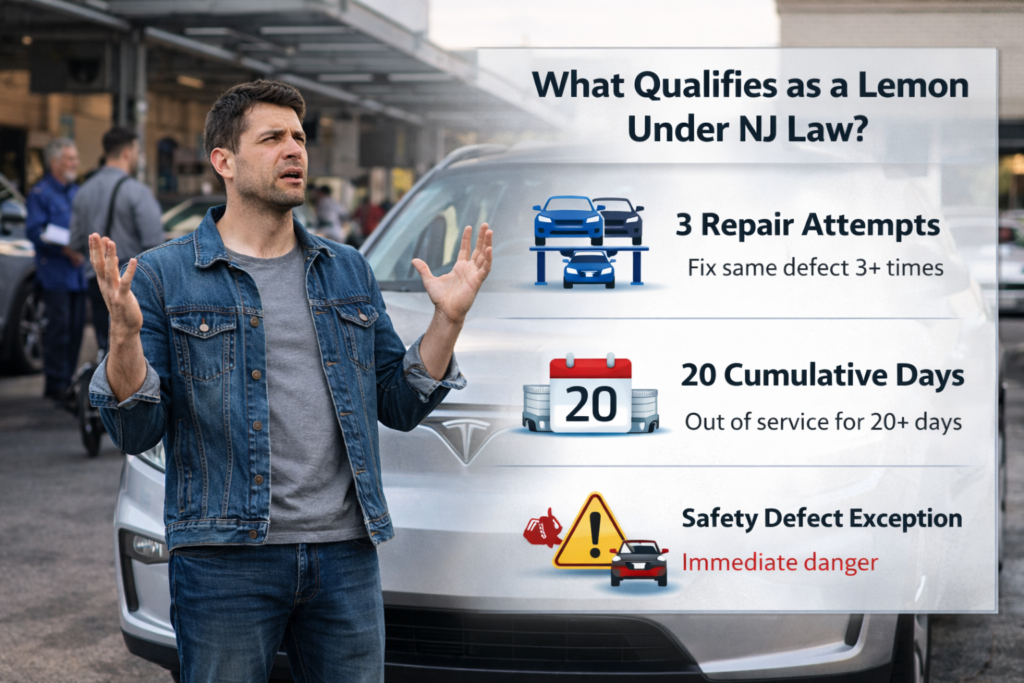
You’ve been back to the dealership four times for the same transmission problem. Or maybe your brand-new SUV has spent three weeks in the shop over the past six months. You’re frustrated, you’re losing money on rental cars, and you’re starting to wonder: Is my vehicle a lemon? New Jersey has one of the strongest Lemon Laws in the United States, but many consumers don’t know whether their situation qualifies. Dealerships certainly won’t tell you—they’d rather keep attempting repairs indefinitely than process a buyback. This comprehensive guide will explain exactly what qualifies as a lemon under New Jersey law, the specific criteria your vehicle must meet, what types of defects are covered, and the critical deadlines you need to know. By the end, you’ll know whether you have a lemon law case and what steps to take next. New Jersey’s Lemon Law Protection Window The first requirement is timing. Under N.J.S.A. 56:12-29, New Jersey’s Lemon Law protects vehicles when defects first appear within: 24 months OR 24,000 miles (whichever comes first) from the original delivery date. This is one of the most generous protection windows in the country. Many states offer only 12 months or 12,000 miles. What “First Appear” Means The key phrase is “first appear.” You don’t need to win your case within 24 months—the defect just needs to first show up within that window. Example: As long as the problem first manifests within 24 months or 24,000 miles, you’re protected under New Jersey law. What Happens After 24 Months? If your defect first appears after the 24-month/24,000-mile window closes, you’re no longer covered under New Jersey’s state Lemon Law. However, you may still have federal protection under the Magnuson-Moss Warranty Act, which applies as long as your manufacturer’s warranty is still active. Most new vehicles come with 3-year/36,000-mile bumper-to-bumper warranties, so even if you’re outside NJ’s Lemon Law window, you may still have legal recourse. The “3 Repair Attempts” Rule New Jersey law presumes a vehicle is a lemon if the manufacturer has had three or more attempts to repair the same substantial defect, and the problem persists. What Counts as a “Repair Attempt” A repair attempt is any occasion when: It doesn’t matter if they: Each visit where you report the same issue counts as a repair attempt. The Defect Must Be “The Same” The three attempts must be for the same defect. Three separate, unrelated problems generally don’t combine to meet this threshold. Example of qualifying attempts: Example of non-qualifying attempts: What If They Fix It on the Fourth Try? If the manufacturer successfully repairs the defect on the fourth or subsequent attempt, and it doesn’t recur, you may no longer have a lemon law claim for that specific issue. However, if the problem returns after the “successful” repair, the clock starts again. The “20 Cumulative Days” Rule New Jersey also presumes a vehicle is a lemon if it has been out of service for 20 or more cumulative days due to repairs. This is a powerful alternative pathway that doesn’t require multiple attempts for the same defect. How Cumulative Days Work The 20 days: Example: What Counts Toward the 20 Days Days count if: What Doesn’t Count Days generally don’t count if: Loaner Vehicles Don’t Erase Your Rights Some consumers worry that if the dealer provides a loaner vehicle, those days won’t count. This is false. Even if you have a loaner, if your vehicle is out of service for repairs, those days count toward the 20-day threshold. The law focuses on whether your vehicle is unavailable, not whether you have alternative transportation. The Safety Defect Exception New Jersey law includes a critical exception for safety defects—problems that could cause death or serious bodily injury. If your vehicle has a safety defect that substantially impairs safe operation, one repair attempt may be sufficient to trigger lemon law protections. Examples of Safety Defects Proving a Safety Defect To qualify under the safety defect exception, you typically need: Because the standard is high (death or serious injury), consult an experienced lemon law attorney if you believe you have a safety defect case. What “Substantially Impairs Use, Value, or Safety” Means New Jersey’s Lemon Law doesn’t cover every minor annoyance. The defect must substantially impair the vehicle’s: Examples of Substantial Impairment Use Impairment: Value Impairment: Safety Impairment: What Does NOT Substantially Impair Minor issues generally don’t qualify: The standard is “substantial.” If the average consumer would consider it a significant problem that affects their ability to use, sell, or safely operate the vehicle, it likely qualifies. What Types of Vehicles Are Covered New Jersey’s Lemon Law is unusually broad. It covers: New Passenger Vehicles Any new car, truck, SUV, or van sold or leased in New Jersey for personal, family, or household use. This includes: Motorcycles New Jersey is one of the few states that explicitly covers motorcycles under its Lemon Law. If you purchased a new motorcycle in NJ and it has a qualifying defect, you have the same protections as a car owner. Leased Vehicles As discussed in our dedicated guide on leased vehicles, New Jersey explicitly protects lessees under N.J.S.A. 56:12-30. You don’t need to own the vehicle—leasing it is enough. Electric Vehicles All new EVs sold or leased in NJ are covered: What Vehicles Are NOT Covered Under State Lemon Law Used Cars New Jersey’s primary Lemon Law (N.J.S.A. 56:12-29) applies only to new vehicles. However, New Jersey has a separate Used Car Lemon Law (N.J.S.A. 56:12-68) that provides limited protections for used car buyers if: The used car law is much weaker than the new car law. Consult an attorney if you have a used car issue. Motor Homes (Living Quarters) The “living quarters” portion of motor homes is not covered under NJ Lemon Law. However, the vehicle chassis and drivetrain are covered. Commercial Vehicles Vehicles purchased primarily for business use generally aren’t covered, though there are exceptions if the business use is minimal. New Jersey Ranked #2 in Consumer Protections
What Qualifies as a Lemon Under NJ Law? Read More »