lemonlawnj.com

Uncategorized

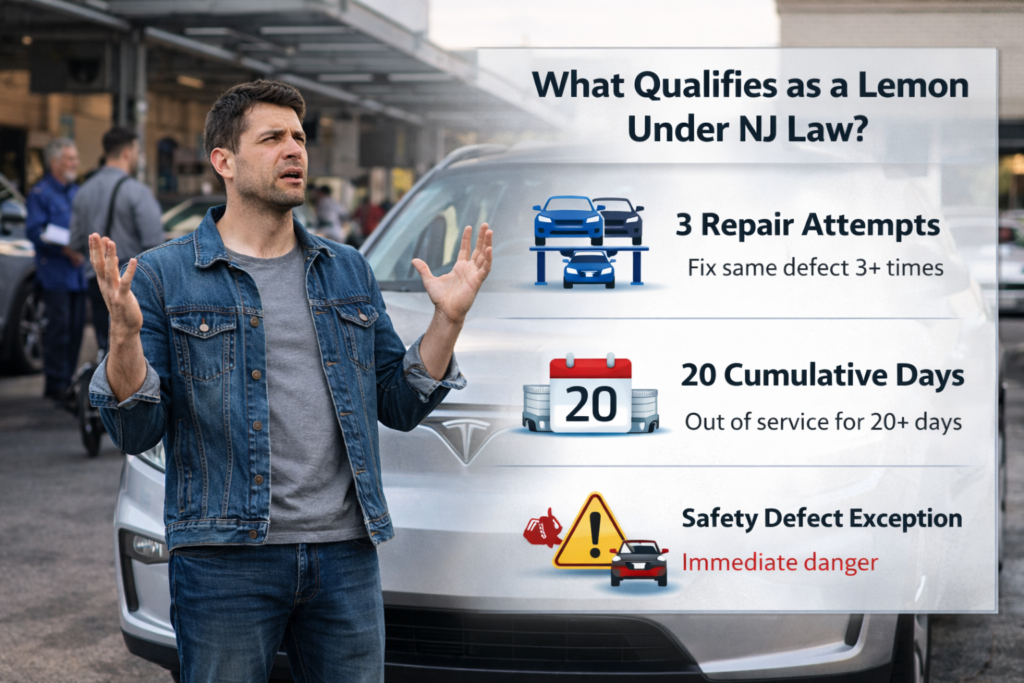
What Qualifies as a Lemon Under NJ Law?

What Qualifies as a Lemon Under NJ Law?

You’ve been back to the dealership four times for the same transmission problem. Or maybe your brand-new SUV has spent three weeks in the shop over the past six months. You’re frustrated, you’re losing money on rental cars, and you’re starting to wonder: Is my vehicle a lemon? New Jersey has one of the strongest Lemon Laws in the United States, but many consumers don’t know whether their situation qualifies. Dealerships certainly won’t tell you—they’d rather keep attempting repairs indefinitely than process a buyback. This comprehensive guide will explain exactly what qualifies as a lemon under New Jersey law, the specific criteria your vehicle must meet, what types of defects are covered, and the critical deadlines you need to know. By the end, you’ll know whether you have a lemon law case and what steps to take next. New Jersey’s Lemon Law Protection Window The first requirement is timing. Under N.J.S.A. 56:12-29, New Jersey’s Lemon Law protects vehicles when defects first appear within: 24 months OR 24,000 miles (whichever comes first) from the original delivery date. This is one of the most generous protection windows in the country. Many states offer only 12 months or 12,000 miles. What “First Appear” Means The key phrase is “first appear.” You don’t need to win your case within 24 months—the defect just needs to first show up within that window. Example: As long as the problem first manifests within 24 months or 24,000 miles, you’re protected under New Jersey law. What Happens After 24 Months? If your defect first appears after the 24-month/24,000-mile window closes, you’re no longer covered under New Jersey’s state Lemon Law. However, you may still have federal protection under the Magnuson-Moss Warranty Act, which applies as long as your manufacturer’s warranty is still active. Most new vehicles come with 3-year/36,000-mile bumper-to-bumper warranties, so even if you’re outside NJ’s Lemon Law window, you may still have legal recourse. The “3 Repair Attempts” Rule New Jersey law presumes a vehicle is a lemon if the manufacturer has had three or more attempts to repair the same substantial defect, and the problem persists. What Counts as a “Repair Attempt” A repair attempt is any occasion when: It doesn’t matter if they: Each visit where you report the same issue counts as a repair attempt. The Defect Must Be “The Same” The three attempts must be for the same defect. Three separate, unrelated problems generally don’t combine to meet this threshold. Example of qualifying attempts: Example of non-qualifying attempts: What If They Fix It on the Fourth Try? If the manufacturer successfully repairs the defect on the fourth or subsequent attempt, and it doesn’t recur, you may no longer have a lemon law claim for that specific issue. However, if the problem returns after the “successful” repair, the clock starts again. The “20 Cumulative Days” Rule New Jersey also presumes a vehicle is a lemon if it has been out of service for 20 or more cumulative days due to repairs. This is a powerful alternative pathway that doesn’t require multiple attempts for the same defect. How Cumulative Days Work The 20 days: Example: What Counts Toward the 20 Days Days count if: What Doesn’t Count Days generally don’t count if: Loaner Vehicles Don’t Erase Your Rights Some consumers worry that if the dealer provides a loaner vehicle, those days won’t count. This is false. Even if you have a loaner, if your vehicle is out of service for repairs, those days count toward the 20-day threshold. The law focuses on whether your vehicle is unavailable, not whether you have alternative transportation. The Safety Defect Exception New Jersey law includes a critical exception for safety defects—problems that could cause death or serious bodily injury. If your vehicle has a safety defect that substantially impairs safe operation, one repair attempt may be sufficient to trigger lemon law protections. Examples of Safety Defects Proving a Safety Defect To qualify under the safety defect exception, you typically need: Because the standard is high (death or serious injury), consult an experienced lemon law attorney if you believe you have a safety defect case. What “Substantially Impairs Use, Value, or Safety” Means New Jersey’s Lemon Law doesn’t cover every minor annoyance. The defect must substantially impair the vehicle’s: Examples of Substantial Impairment Use Impairment: Value Impairment: Safety Impairment: What Does NOT Substantially Impair Minor issues generally don’t qualify: The standard is “substantial.” If the average consumer would consider it a significant problem that affects their ability to use, sell, or safely operate the vehicle, it likely qualifies. What Types of Vehicles Are Covered New Jersey’s Lemon Law is unusually broad. It covers: New Passenger Vehicles Any new car, truck, SUV, or van sold or leased in New Jersey for personal, family, or household use. This includes: Motorcycles New Jersey is one of the few states that explicitly covers motorcycles under its Lemon Law. If you purchased a new motorcycle in NJ and it has a qualifying defect, you have the same protections as a car owner. Leased Vehicles As discussed in our dedicated guide on leased vehicles, New Jersey explicitly protects lessees under N.J.S.A. 56:12-30. You don’t need to own the vehicle—leasing it is enough. Electric Vehicles All new EVs sold or leased in NJ are covered: What Vehicles Are NOT Covered Under State Lemon Law Used Cars New Jersey’s primary Lemon Law (N.J.S.A. 56:12-29) applies only to new vehicles. However, New Jersey has a separate Used Car Lemon Law (N.J.S.A. 56:12-68) that provides limited protections for used car buyers if: The used car law is much weaker than the new car law. Consult an attorney if you have a used car issue. Motor Homes (Living Quarters) The “living quarters” portion of motor homes is not covered under NJ Lemon Law. However, the vehicle chassis and drivetrain are covered. Commercial Vehicles Vehicles purchased primarily for business use generally aren’t covered, though there are exceptions if the business use is minimal. New Jersey Ranked #2 in Consumer Protections

What Qualifies as a Lemon Under NJ Law? Read More »
Tesla Lemon Law in NJ: What Owners Must Know

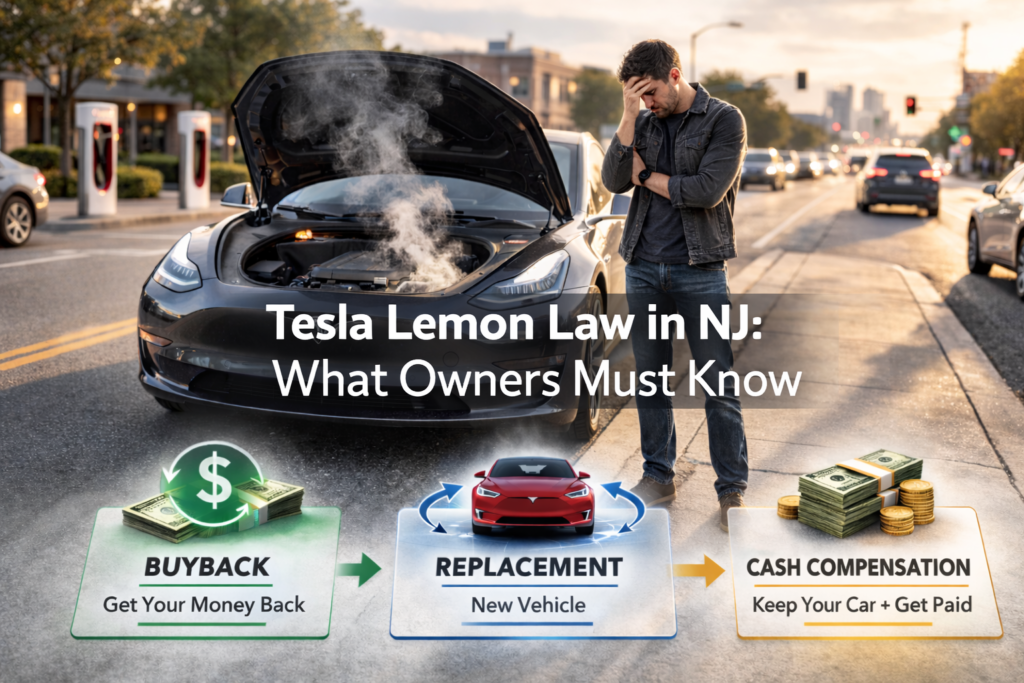
Tesla Lemon Law in NJ: What Owners Must Know

Tesla owners in New Jersey love their vehicles—until they don’t. The cutting-edge technology, instant acceleration, and over-the-air updates create an ownership experience unlike any traditional car. But when something goes wrong with a Tesla, the frustration can be just as unique. Touchscreens that freeze mid-drive. Full Self-Driving that doesn’t. Charging ports that refuse to open. Suspension systems that fail prematurely. Paint defects straight from the factory. If you’re experiencing repeated issues with your Tesla, you need to know this: New Jersey’s Lemon Law fully protects Tesla owners. Whether you own a Model 3, Model Y, Model S, Model X, or even a Cybertruck, you have the same consumer rights as any other vehicle owner in the state. This guide will walk you through how New Jersey’s Lemon Law applies to Tesla vehicles, the most common defects we see, how recalls and over-the-air updates factor into your case, and the steps you need to take to protect your rights. New Jersey’s Lemon Law Covers Tesla Vehicles Under N.J.S.A. 56:12-29 to 56:12-49, New Jersey’s Lemon Law applies to all new motor vehicles sold or leased in the state, including electric vehicles like Tesla. The law provides protection if: Tesla vehicles are not exempt. In fact, because Tesla combines automotive engineering with complex software systems, Teslas often present unique lemon law scenarios that traditional manufacturers don’t face. How Tesla’s Warranty Aligns with NJ Lemon Law Tesla offers one of the most comprehensive warranties in the automotive industry: New Jersey’s Lemon Law protection window is 24 months or 24,000 miles—which falls comfortably within Tesla’s Basic Vehicle Warranty. Here’s what this means in practice: If your Tesla develops a recurring defect within the first 2 years or 24,000 miles, and Tesla can’t fix it after a reasonable number of attempts, you’re entitled to a buyback, replacement, or cash settlement under New Jersey law. After the 24-month window closes but while your vehicle is still under Tesla’s warranty, you can pursue a claim under the Magnuson-Moss Warranty Act, a federal law that provides similar protections with different procedural requirements. Most Common Tesla Defects in New Jersey Tesla vehicles are technological marvels, but they’re not immune to defects. Based on our experience representing New Jersey Tesla owners, here are the most common issues we see: 1. Full Self-Driving (FSD) and Autopilot Failures Tesla’s advanced driver-assistance systems are a major selling point—but when they malfunction, they create serious safety concerns. Common FSD/Autopilot issues include: These aren’t minor inconveniences. When a safety system fails repeatedly, it can qualify as a substantial defect under New Jersey’s Lemon Law. 2. Touchscreen and Infotainment Failures Tesla’s center touchscreen controls nearly every vehicle function—climate, navigation, mirrors, wipers, and more. When the screen fails, the vehicle becomes nearly unusable. Common touchscreen issues: Tesla has issued multiple recalls for touchscreen failures, particularly in Model S and Model X vehicles from certain model years. If the recall repair doesn’t fix your screen, or if the problem returns, you may have a lemon law claim. 3. Suspension and Alignment Problems Multiple Tesla models—especially the Model S and Model X—have documented suspension issues. Defects include: Tesla has issued service bulletins for some of these issues, but if your vehicle requires repeated suspension repairs within the lemon law protection window, you may be entitled to relief. 4. Charging Port Malfunctions The charging port is essential to vehicle operation. When it fails, you can’t charge your car—rendering it useless. Common charging port defects: If Tesla can’t permanently fix a charging port issue after multiple attempts, the vehicle substantially loses its value and use. 5. Paint, Panel Fit, and Build Quality Defects Tesla has faced criticism for inconsistent build quality, particularly in earlier Model 3 and Model Y production runs. Quality issues include: While cosmetic-only issues generally don’t qualify under lemon law, defects that affect vehicle function—like water leaks causing electrical problems—absolutely do. 6. Rearview Camera and Sensor Failures Backup cameras are federally mandated safety equipment. When they fail, the vehicle is not only annoying to use—it’s potentially unsafe and may not be street-legal. Common camera/sensor issues: If Tesla can’t resolve camera or sensor failures after multiple service visits, the safety implications can support a lemon law claim. Does a Tesla Recall Count as a Repair Attempt? This is one of the most common questions we get from Tesla owners: “Tesla issued a recall for my problem. Does that count toward my lemon law case?” The answer: It depends. When a Recall Supports Your Lemon Law Claim A recall can absolutely strengthen your case if: In these scenarios, both your pre-recall service visits and post-recall repairs count as repair attempts under New Jersey law. When a Recall Alone Isn’t Enough If Tesla issues a recall and the single recall repair fully resolves the problem with no further issues, that typically won’t meet the lemon law threshold. New Jersey requires either: A one-time recall repair that works doesn’t meet these criteria. Example: Touchscreen Recall Tesla recalled approximately 135,000 Model S and Model X vehicles in 2021 for touchscreen failures caused by flash memory degradation. If you experienced touchscreen failures before the recall, had the recall repair performed, and the screen still fails after the recall, those post-recall failures count as additional repair attempts. Document everything: both your pre-recall service history and any issues that occur after the recall repair. Do Over-the-Air Software Updates Count as Repair Attempts? Tesla’s over-the-air (OTA) update capability is innovative—but it also raises unique lemon law questions. When OTA Updates Do Count An OTA software update can count as a repair attempt if: Example: You report phantom braking issues. Tesla tells you an upcoming software update will resolve it. The update is pushed to your car, but phantom braking continues. That OTA update counts as a failed repair attempt. When OTA Updates Don’t Count Generic software updates that Tesla pushes fleet-wide for general improvements (not targeted at your specific complaint) typically don’t count as repair attempts. Similarly, if you never reported the issue to Tesla and they

Tesla Lemon Law in NJ: What Owners Must Know Read More »