
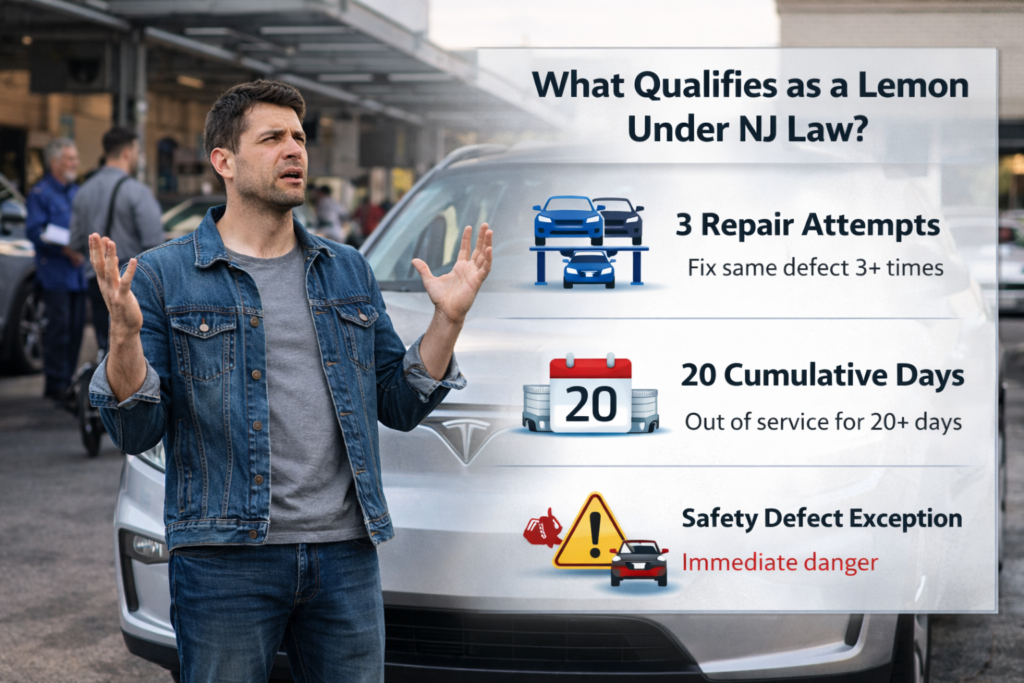
You’ve been back to the dealership four times for the same transmission problem. Or maybe your brand-new SUV has spent three weeks in the shop over the past six months. You’re frustrated, you’re losing money on rental cars, and you’re starting to wonder: Is my vehicle a lemon?
New Jersey has one of the strongest Lemon Laws in the United States, but many consumers don’t know whether their situation qualifies. Dealerships certainly won’t tell you—they’d rather keep attempting repairs indefinitely than process a buyback.
This comprehensive guide will explain exactly what qualifies as a lemon under New Jersey law, the specific criteria your vehicle must meet, what types of defects are covered, and the critical deadlines you need to know.
By the end, you’ll know whether you have a lemon law case and what steps to take next.
New Jersey’s Lemon Law Protection Window
The first requirement is timing. Under N.J.S.A. 56:12-29, New Jersey’s Lemon Law protects vehicles when defects first appear within:
24 months OR 24,000 miles (whichever comes first) from the original delivery date.
This is one of the most generous protection windows in the country. Many states offer only 12 months or 12,000 miles.
What “First Appear” Means
The key phrase is “first appear.” You don’t need to win your case within 24 months—the defect just needs to first show up within that window.
Example:
- You buy a new car in January 2025
- In December 2026 (23 months later), the engine starts misfiring
- You’re still covered, even if the case isn’t resolved until 2027
As long as the problem first manifests within 24 months or 24,000 miles, you’re protected under New Jersey law.
What Happens After 24 Months?
If your defect first appears after the 24-month/24,000-mile window closes, you’re no longer covered under New Jersey’s state Lemon Law.
However, you may still have federal protection under the Magnuson-Moss Warranty Act, which applies as long as your manufacturer’s warranty is still active.
Most new vehicles come with 3-year/36,000-mile bumper-to-bumper warranties, so even if you’re outside NJ’s Lemon Law window, you may still have legal recourse.
The “3 Repair Attempts” Rule
New Jersey law presumes a vehicle is a lemon if the manufacturer has had three or more attempts to repair the same substantial defect, and the problem persists.
What Counts as a “Repair Attempt”
A repair attempt is any occasion when:
- You bring the vehicle to an authorized dealership or service center
- You report a specific defect or symptom
- The service center attempts to diagnose or repair that issue
It doesn’t matter if they:
- Can’t find the problem
- Replace parts but the issue continues
- Tell you “it’s normal” or “we can’t replicate it”
Each visit where you report the same issue counts as a repair attempt.
The Defect Must Be “The Same”
The three attempts must be for the same defect. Three separate, unrelated problems generally don’t combine to meet this threshold.
Example of qualifying attempts:
- Visit 1: Transmission slips when shifting from 2nd to 3rd gear
- Visit 2: Transmission still slips; dealer replaces solenoid
- Visit 3: Slipping continues; dealer replaces transmission valve body
- Result: Three attempts for the same defect (transmission slipping)
Example of non-qualifying attempts:
- Visit 1: Air conditioning doesn’t cool
- Visit 2: Bluetooth won’t connect
- Visit 3: Windshield wipers skip
- Result: Three separate defects, not three attempts at the same one
What If They Fix It on the Fourth Try?
If the manufacturer successfully repairs the defect on the fourth or subsequent attempt, and it doesn’t recur, you may no longer have a lemon law claim for that specific issue.
However, if the problem returns after the “successful” repair, the clock starts again.
The “20 Cumulative Days” Rule
New Jersey also presumes a vehicle is a lemon if it has been out of service for 20 or more cumulative days due to repairs.
This is a powerful alternative pathway that doesn’t require multiple attempts for the same defect.
How Cumulative Days Work
The 20 days:
- Do NOT need to be consecutive—you can add up all repair visits
- Can involve different issues—it doesn’t have to be the same defect
- Count from the day you drop off the vehicle until the day you pick it up
Example:
- March: Transmission repair, 6 days in shop
- May: Engine misfire diagnosis, 4 days in shop
- July: Electrical problem, 5 days in shop
- September: Transmission issue returns, 6 days in shop
- Total: 21 cumulative days = potential lemon law case
What Counts Toward the 20 Days
Days count if:
- The vehicle is at an authorized service center for covered warranty repairs
- You do not have use of the vehicle during that time
- The repair is for a substantial defect (not routine maintenance)
What Doesn’t Count
Days generally don’t count if:
- You delay picking up the vehicle after repairs are complete
- The delay is due to parts on backorder through no fault of the manufacturer (this is a gray area—consult an attorney)
- The service is routine maintenance (oil changes, tire rotations, etc.)
Loaner Vehicles Don’t Erase Your Rights
Some consumers worry that if the dealer provides a loaner vehicle, those days won’t count.
This is false. Even if you have a loaner, if your vehicle is out of service for repairs, those days count toward the 20-day threshold.
The law focuses on whether your vehicle is unavailable, not whether you have alternative transportation.
The Safety Defect Exception
New Jersey law includes a critical exception for safety defects—problems that could cause death or serious bodily injury.
If your vehicle has a safety defect that substantially impairs safe operation, one repair attempt may be sufficient to trigger lemon law protections.
Examples of Safety Defects
- Brake failures: Brakes don’t engage, require excessive force, or fail intermittently
- Steering malfunctions: Loss of power steering, steering wheel locks up, vehicle pulls dangerously to one side
- Sudden acceleration or stalling: Engine surges forward unexpectedly or dies while driving
- Airbag failures: Airbags deploy without cause or fail to deploy in a collision
- Fire risks: Electrical fires, fuel leaks, battery fires
- Structural defects: Frame cracks, suspension collapses, wheel separation
Proving a Safety Defect
To qualify under the safety defect exception, you typically need:
- Documentation of the dangerous condition
- Evidence that you reported it to the manufacturer
- Expert testimony or technical service bulletins confirming the safety risk
Because the standard is high (death or serious injury), consult an experienced lemon law attorney if you believe you have a safety defect case.
What “Substantially Impairs Use, Value, or Safety” Means
New Jersey’s Lemon Law doesn’t cover every minor annoyance. The defect must substantially impair the vehicle’s:
- Use: You can’t drive it normally or for its intended purpose
- Value: The defect significantly reduces what the vehicle is worth
- Safety: The defect creates a risk of harm to occupants or others
Examples of Substantial Impairment
Use Impairment:
- Transmission that won’t shift properly
- Engine that stalls or won’t start reliably
- Air conditioning that doesn’t work (in a daily-use vehicle in NJ summers, this can be substantial)
- Infotainment system that controls critical vehicle functions and repeatedly fails
Value Impairment:
- Unrepaired paint defects that cause premature rusting
- Persistent electrical issues that remain on the vehicle history report
- Repeated major component replacements (transmission, engine) that tank resale value
Safety Impairment:
- Brake problems
- Steering failures
- Defects that cause the vehicle to be undrivable or unsafe
What Does NOT Substantially Impair
Minor issues generally don’t qualify:
- Cosmetic scratches or dings (unless they lead to rust/corrosion)
- Squeaks and rattles that don’t affect operation
- Minor trim pieces that are loose but don’t affect safety
- Preferences about seat comfort or radio quality
The standard is “substantial.” If the average consumer would consider it a significant problem that affects their ability to use, sell, or safely operate the vehicle, it likely qualifies.
What Types of Vehicles Are Covered
New Jersey’s Lemon Law is unusually broad. It covers:
New Passenger Vehicles
Any new car, truck, SUV, or van sold or leased in New Jersey for personal, family, or household use.
This includes:
- Sedans, coupes, hatchbacks
- SUVs and crossovers
- Pickup trucks
- Minivans
Motorcycles
New Jersey is one of the few states that explicitly covers motorcycles under its Lemon Law.
If you purchased a new motorcycle in NJ and it has a qualifying defect, you have the same protections as a car owner.
Leased Vehicles
As discussed in our dedicated guide on leased vehicles, New Jersey explicitly protects lessees under N.J.S.A. 56:12-30.
You don’t need to own the vehicle—leasing it is enough.
Electric Vehicles
All new EVs sold or leased in NJ are covered:
- Tesla (Model 3, Y, S, X, Cybertruck)
- Chevrolet Bolt
- Ford Mustang Mach-E, F-150 Lightning
- Rivian R1T, R1S
- Volkswagen ID.4
- Hyundai Ioniq 5/6
- And all other new EVs
What Vehicles Are NOT Covered Under State Lemon Law
Used Cars
New Jersey’s primary Lemon Law (N.J.S.A. 56:12-29) applies only to new vehicles.
However, New Jersey has a separate Used Car Lemon Law (N.J.S.A. 56:12-68) that provides limited protections for used car buyers if:
- The vehicle is less than 7 years old or has fewer than 100,000 miles
- A serious defect appears within 90 days or 3,000 miles of purchase
- The dealer refuses to repair it
The used car law is much weaker than the new car law. Consult an attorney if you have a used car issue.
Motor Homes (Living Quarters)
The “living quarters” portion of motor homes is not covered under NJ Lemon Law. However, the vehicle chassis and drivetrain are covered.
Commercial Vehicles
Vehicles purchased primarily for business use generally aren’t covered, though there are exceptions if the business use is minimal.
New Jersey Ranked #2 in Consumer Protections
According to the Center for Auto Safety, New Jersey ranks 2nd in the nation for lemon law consumer protections, behind only Connecticut.
Why is NJ’s law so strong?
- 24-month/24,000-mile protection window (most states offer 12-18 months)
- Covers leased vehicles explicitly
- Covers motorcycles (rare among states)
- Fee-shifting provision: Manufacturer pays all attorney fees if you win
- Broad definition of “substantial impairment”
- Strong presumptions (3 attempts or 20 days creates a presumption in your favor)
If you live in New Jersey and have a defective vehicle, you’re in one of the best possible states for legal recourse.
When the 24-Month Window Expires: Magnuson-Moss Warranty Act
If your defect first appears after 24 months or 24,000 miles, but your vehicle is still under the manufacturer’s warranty, you may have federal protection under the Magnuson-Moss Warranty Act.
This federal law:
- Applies to any consumer product over $25 (including vehicles)
- Protects you as long as the manufacturer’s warranty is active
- Requires only 3 repair attempts for the same issue (vs. NJ’s 3 attempts)
- Offers cash compensation while you keep the vehicle, rather than a buyback
Magnuson-Moss also includes fee-shifting, meaning the manufacturer pays your attorney fees if you prevail.
Many New Jersey consumers don’t realize they have this federal backup protection when state law no longer applies.
What Documentation You Need
If you think you have a lemon, documentation is everything.
Essential Records
Repair Orders (ROs)
Every time you take the vehicle in for service, get a printed repair order that includes:
- Date and mileage
- Your description of the problem (complaint)
- Dealer’s diagnosis
- Work performed
- Parts replaced
- Technician notes
- Dates vehicle was dropped off and picked up
Written Notices to Manufacturer
New Jersey law requires that you give the manufacturer written notice and a final opportunity to repair. Your attorney will typically handle this, but if you’ve sent any letters or emails to the manufacturer, keep copies.
Proof of Purchase or Lease
- Bill of sale
- Lease agreement
- Registration
- Title (if applicable)
Warranty Information
- Copy of the manufacturer’s warranty booklet
- Any extended warranty documents
Personal Log
In addition to official paperwork, keep your own notes:
- When symptoms first appeared
- How the defect affects your daily use of the vehicle
- Any safety incidents caused by the defect
- Communication with service advisors
- Dates of service and days out of service
This personal narrative can be powerful evidence.
Common Myths About New Jersey Lemon Law
Myth 1: “I Have to Use Arbitration Through the Manufacturer”
False. You’re not required to use the manufacturer’s arbitration program (like BBB Auto Line). You can go straight to hiring an attorney.
In fact, manufacturer-run arbitration programs are often biased in favor of the manufacturer.
Myth 2: “Lemon Law Only Covers Engines and Transmissions”
False. Any substantial defect affecting use, value, or safety is covered—including electrical systems, HVAC, infotainment, brakes, steering, suspension, and more.
Myth 3: “I Can’t File a Claim If I’m Still Making Payments”
False. You can pursue a lemon law case whether you financed, leased, or paid cash for the vehicle. Your loan status doesn’t affect your rights.
Myth 4: “The Dealer Will Blacklist Me If I File a Claim”
False. The claim is against the manufacturer, not the dealer. And it’s illegal for a manufacturer to retaliate against you for exercising your legal rights.
Myth 5: “I’ll Have to Pay Thousands in Legal Fees”
False. Thanks to New Jersey’s fee-shifting provision, the manufacturer pays all attorney fees if you win. Experienced lemon law attorneys work on contingency—you pay nothing out of pocket.
What You’re Entitled to If You Win
If your lemon law case is successful, New Jersey law requires the manufacturer to provide one of the following:
Full Buyback (Repurchase)
The manufacturer refunds:
- Full purchase price
- All taxes and fees
- Registration costs
- Finance charges (if applicable)
- Minus a small mileage offset for miles driven before the first defect report
Replacement Vehicle
A new vehicle of comparable make and model, at no cost to you.
Cash Settlement (Under Magnuson-Moss)
If pursuing a federal claim, you may negotiate a cash settlement while keeping the vehicle, reflecting its diminished value.
Your attorney will help you determine which remedy makes the most sense for your situation.
Next Steps: What to Do If You Think You Have a Lemon
If your vehicle meets the criteria outlined in this guide, here’s what to do:
1. Stop Driving It (If Unsafe)
If the defect poses a safety risk, stop driving the vehicle immediately. Document the safety issue and contact an attorney.
2. Gather Your Documentation
Collect all repair orders, communications, and records related to the defect.
3. Consult an Experienced NJ Lemon Law Attorney
Schedule a free consultation. An attorney will review your case and tell you whether you qualify.
4. Do Not Accept a Dealer’s “Final Offer” Without Legal Advice
Dealers often pressure consumers into accepting lowball settlements. Don’t sign anything until you’ve spoken with an attorney.
5. Act Quickly
While you don’t have to file within 24 months, the sooner you act, the stronger your case. Documentation fades, and delays can hurt your claim.
You Have Rights. Use Them.
New Jersey’s Lemon Law exists to protect consumers like you from being stuck with defective vehicles. Manufacturers have entire legal teams defending their interests—you deserve experienced representation too.
The best part? You pay nothing. The manufacturer covers all legal fees if you prevail.
If you’ve been back to the dealership three or more times for the same problem, or your car has been in the shop for 20+ days, you may have a lemon law case.
Key Takeaways:
- Defects must first appear within 24 months or 24,000 miles
- Three repair attempts for the same issue = presumed lemon
- 20+ cumulative days out of service = presumed lemon
- Safety defects may qualify after just one failed repair
- Leased vehicles, motorcycles, and EVs are all covered
- Manufacturer pays all attorney fees if you win
Don’t let a defective vehicle drain your time, money, and peace of mind. You have powerful legal protections—and we’re here to help you use them.
Need help with your lemon law case? Contact us today for a free consultation.